
Let’s have an honest conversation about burnout.
Because I think we’ve got ourselves into a bit of a mess with this one.
We’re exhausted all the time.
We’re stressed.
We’re overwhelmed.
We’re struggling to sleep.
We’re snapping at people we love.
We’re losing interest in things we used to enjoy.
We’re dragging ourselves through the day with coffee, adrenaline and sheer determination.
And somehow, we’ve decided that this is normal.
We call it being busy.
We call it adult life.
We call it having a lot on.
We laugh about how tired we are.
“I’m knackered.”
“I need a holiday.”
“It’s been a mad week.”
Then Monday comes around and we do it all again.
But here’s the question I’d really like you to think about:
What if you’re not just tired?
What if you’ve been running on empty for so long that you’ve forgotten what having energy actually feels like?
Burnout doesn’t always look the way you think it does
You might imagine burnout as someone sitting at their desk crying, unable to get out of bed.
Sometimes it looks like that.
But often it doesn’t.
Sometimes burnout looks like the person who never stops.
The person who gets everything done.
The person everyone relies on.
The person who says “I’m fine” because, technically, they are still functioning.
They’re going to work.
They’re answering emails.
They’re getting the children to school.
They’re cooking dinner.
They’re keeping the business going.
They’re showing up for everyone.
They’re just doing it while feeling absolutely bloody exhausted.
And because they’re still functioning, they assume they can’t possibly be burned out.
This is one of the biggest traps.
You can be functioning and still be struggling.
In fact, sometimes functioning is exactly what makes burnout difficult to spot.
You become so good at pushing through that even you don’t realise how much pushing you’re doing.
Here’s what burnout can actually feel like
You wake up tired.
Not “I stayed up too late” tired.
Tired before the day has even started.
You might lie there thinking about everything you’ve got to do.
Your brain starts its morning meeting before you’ve even got out of bed.
Emails.
Bills.
Work.
Children.
Appointments.
That conversation you’ve been avoiding.
The thing you forgot yesterday.
The thing you absolutely must remember today.
And then you get up and get on with it.
Except you’re irritable.
Things that wouldn’t normally bother you suddenly make you want to scream.
Someone asks you a perfectly reasonable question and you feel disproportionately angry.
Then you feel guilty because you know they didn’t deserve that.
You might stop enjoying things.
You don’t want to go out.
You don’t want to see people.
You can’t be bothered with hobbies.
Even things that are supposed to be relaxing feel like another item on your to-do list.
And sex?
Forget it.
Your body is exhausted and your brain is still running at 100 miles an hour.
Then there’s sleep.
You desperately need it.
But when you finally get into bed, your mind decides this is the perfect time to replay the last six months of your life.
And even when you sleep, you don’t necessarily wake up feeling restored.
So you drink more coffee.
Push a little harder.
Promise yourself you’ll slow down next week.
Except next week is always busy too.
And this is where things get interesting
Because burnout isn’t simply about feeling tired.
It’s what can happen when stress and demands continue for long enough that your ability to recover starts falling behind.
Your body and mind don’t get a proper opportunity to come back down.
You spend too much time in go mode.
Then you wonder why you can’t relax.
And there is increasing evidence that burnout isn’t something we should simply shrug off as modern life.
A systematic review of prospective studies found burnout was associated with a range of physical and psychological outcomes, including prolonged fatigue, insomnia, depressive symptoms, headaches, gastrointestinal problems and cardiovascular disease.
A more recent systematic review and meta-analysis looking specifically at cardiovascular disease found an association between burnout and increased cardiovascular risk, although the researchers were careful to point out limitations in the evidence and that association doesn’t automatically prove causation.
That’s worth paying attention to.
Not because you should read this and panic.
Quite the opposite.
It’s a reason to stop ignoring what your body has been telling you.
But here’s the bit I really want you to hear
You don’t have to earn the right to rest by completely falling apart.
Read that again.
You don’t have to wait until you’re signed off work.
You don’t have to wait until you’re crying every morning.
You don’t have to wait until your relationship is suffering.
You don’t have to wait until your body forces you to stop.
You are allowed to say:
“Actually, I’m not doing very well.”
And then do something about it.
Not something dramatic.
Something small.
Something that gives you a chance to breathe.
This is where Reiki can have a place
Now, I’m going to be straight with you.
I’m not going to tell you that Reiki is a magical cure for burnout.
It isn’t.
And if someone promises you that one Reiki treatment will fix your exhaustion, anxiety, stress and entire life, I’d be very sceptical.
Burnout usually has causes.
Maybe you’re working too much.
Maybe you never switch off.
Maybe your boundaries are terrible because everyone else’s needs always seem more important than yours.
Maybe you’re caring for other people.
Maybe you’re carrying responsibilities that nobody sees.
Maybe you’ve been living in survival mode for far longer than you realise.
A Reiki session can’t magically remove those things.
But it can give you something that might be missing from your life completely: a genuine opportunity to stop.
Not scroll.
Not watch television while answering emails.
Not lie in bed worrying.
Not “relax” while mentally writing tomorrow’s to-do list.
Actually stop.
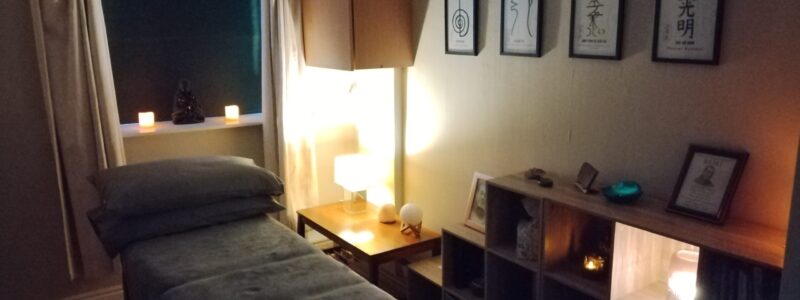
You lie down.
You don’t have to achieve anything.
Nobody needs anything from you.
For that period of time, you don’t have to be productive.
You don’t have to be useful.
You don’t have to look after anybody.
You just get to be there.
And for someone who has spent months or years constantly giving, doing and thinking, that can be incredibly valuable.
But does Reiki actually help?
The honest answer is: we’re still finding out.
And I’d rather tell you that than make big claims that the evidence can’t support.
Research into Reiki has produced some encouraging findings, particularly around stress and anxiety, but the overall evidence isn’t strong enough to say Reiki treats burnout or any particular medical condition.
A systematic review published in 2022 found that Reiki showed potentially beneficial effects for some mental-health symptoms compared with placebo, with stronger evidence for clinically significant stress and anxiety than for burnout itself.
The authors also highlighted the small number of studies and methodological limitations.
Other reviews have reached more cautious conclusions, pointing out that many Reiki studies are small or have methodological weaknesses.
So I won’t promise you a miracle.
What I can say is that Reiki may provide a deeply restful experience and may help some people feel calmer and less stressed.
And sometimes creating the space to rest is more important than we realise.
Maybe your body isn’t failing you
Maybe it’s trying to get your attention.
That exhaustion you’ve been fighting?
That irritability?
That feeling that you can’t cope with one more thing?
That constant need to be alone?
The fact that you can’t remember the last time you felt properly relaxed?
Maybe you don’t need another productivity hack.
Maybe you don’t need another app.
Maybe you don’t need to get up at 5am and start meditating, journaling, exercising and drinking green juice before you’ve even had breakfast.
Maybe you need to stop adding things to your life.
Maybe you need to take something away.
The pressure.
The expectation.
The constant availability.
The belief that everyone else comes first.
And perhaps, for an hour, you need somewhere you can simply lie down and breathe.
If you’re reading this and thinking, “Oh.”
You know that little “oh” I’m talking about.
The one where something suddenly makes sense.
“Maybe that’s why I’ve been feeling like this.”
Don’t ignore it.
You don’t have to diagnose yourself with burnout.
You don’t have to label yourself.
But you can start paying attention.
Ask yourself:
Am I actually tired, or am I completely depleted?
When did I last feel genuinely rested?
Do I enjoy my life, or am I simply managing it?
If nothing changed for the next two years, would I be okay with that?
That last question is the uncomfortable one.
Because sometimes the problem isn’t that we’re having a difficult week.
It’s that we’ve built a life that requires us to be exhausted in order to maintain it.
And that’s something worth looking at.
Reiki might be one part of that process.
Not a magic wand.
Just a quiet place to stop.
To breathe.
To notice.
To reconnect.
And perhaps to begin asking yourself a question you haven’t asked in a very long time:
“What do I actually need?”
Because you are allowed to find out before your body makes the decision for you.