A Gentle Path Through the Change.
A Note From Me Before We Begin
I’ll be upfront about something straight away: I’m a man. That might raise an eyebrow when you see the subject matter of this article, and that’s entirely fair. What I can tell you is that everything I’m about to share has come directly from the women I’ve had the privilege of treating over the years. Session after session, conversation after conversation, a picture has emerged, one I feel compelled to put into words, because what these women have described deserves to be heard more widely.
Reiki is not a cure.
It is not a replacement for medical care.
But what it can be, as so many of my clients have told me in their own words, is a lifeline during one of the most physically and emotionally turbulent periods in a woman’s life.
This article is my attempt to honour their experiences, and to explain with reference to the research available why Reiki may be a genuinely useful complementary therapy for women navigating the menopause.
What Is the Menopause, and Why Does It Matter?
Before diving into Reiki itself, it’s worth setting the scene.
The menopause defined as the point at which a woman has not had a menstrual period for twelve consecutive months typically occurs between the ages of 45 and 55 in the UK, with the average age being around 51. The perimenopause, the transitional phase that precedes it, can begin years earlier and is often where symptoms are at their most disruptive.
According to the NHS, common symptoms include hot flushes, night sweats, difficulty sleeping, low mood, anxiety, brain fog, joint aches, reduced libido, and vaginal dryness and the list goes on.
The British Menopause Society notes that around 75% of women experience vasomotor symptoms such as hot flushes, and for many, these symptoms can last for several years (British Menopause Society, www.thebms.org.uk).
The impact on quality of life can be profound. Women describe feeling like strangers in their own bodies. The emotional toll anxiety, irritability, low self-worth can be just as debilitating as the physical symptoms.
Sleep deprivation alone can cascade into dozens of other problems.
And whilst Hormone Replacement Therapy (HRT) remains a highly effective and increasingly recommended treatment in the UK (NICE Guidelines NG23, www.nice.org.uk/guidance/ng23), not every woman can take it, not every woman wants to, and for many it doesn’t address everything they’re experiencing.
This is where complementary therapies including Reiki can play a meaningful supporting role.
What Is Reiki?
Reiki is a form of energy healing that originated in Japan in the early twentieth century, developed by Mikao Usui.
The word itself translates roughly as “universal life energy.”
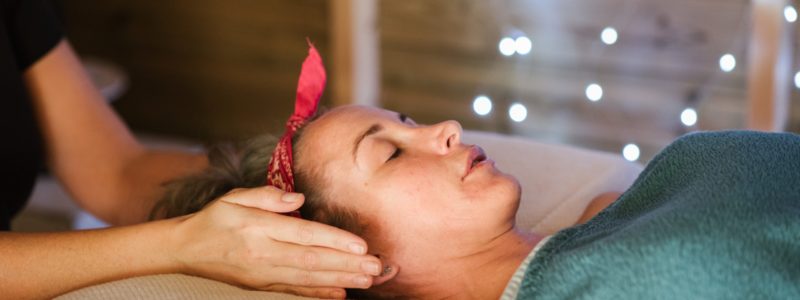
In a typical session, a practitioner places their hands lightly on or just above the client’s body, with the intention of channelling energy to promote relaxation, balance, and wellbeing.
It works by influencing the body’s energy field, reducing stress, and encouraging the parasympathetic nervous system (our “rest and digest” mode) to take over from the stress-driven sympathetic response.
It is non-invasive, deeply relaxing, and requires nothing from the client other than to lie still and breathe.
Reiki is increasingly available within complementary health settings across the UK, and is offered at a number of NHS-affiliated cancer centres and hospices as part of supportive care provision.
What My Clients Have Told Me
Over the years, I’ve worked with a great many women who have come to me specifically because of the menopause.
Some arrived as sceptics, brought along by a friend.
Others had already tried everything they could find and were simply looking for some relief.
What follows are the themes that have come up again and again.
“I finally slept.” This is probably the single most common thing I hear after a first session.
Women who have been lying awake for months either unable to fall asleep or woken repeatedly by night sweats often describe a quality of sleep after a Reiki session that they haven’t experienced in years.
It doesn’t last forever, but it’s a reminder of what rest can feel like, and something to aim for.
“I felt calm for the first time in months.” Anxiety during the perimenopause and menopause is vastly underreported.
Hormonal fluctuations affect the brain’s chemistry directly, and many women find themselves experiencing anxiety that seems to come from nowhere. Reiki’s deep relaxation response appears to offer genuine relief here even if only for a window of time, that window matters.
“My hot flushes were less frequent that week.” I want to be careful with this one, because individual experiences vary enormously.
But it has come up enough times to be worth mentioning.
Some clients have reported a reduction in the frequency or intensity of hot flushes in the days following a session.
Whether this is attributable to Reiki’s effect on the autonomic nervous system, or simply the benefit of reduced overall stress (which is known to trigger flushes), I can’t say with certainty.
“I feel like myself again just for a bit.” This, perhaps, is the most moving thing to hear.
The menopause can rob women of their sense of identity. Reiki seems to offer a reconnection with the self a quieting of the noise that many describe as deeply restorative.
I’m aware that anecdote, however compelling, is not evidence. So let’s look at what the science has to say and I’ll be honest about where the evidence is promising and where it remains limited.
Stress Reduction and the HPA Axis
One of the most well-evidenced effects of Reiki is its ability to reduce stress and activate the parasympathetic nervous system.
A 2010 study published in the Journal of Alternative and Complementary Medicine found that Reiki was significantly more effective than placebo in reducing heart rate and blood pressure under stress conditions (Baldwin et al., 2010 https://doi.org/10.1089/acm.2009.0007).
Since chronic stress is known to worsen menopausal symptoms particularly hot flushes, anxiety, and sleep disruption this is directly relevant.
The hypothalamic-pituitary-adrenal (HPA) axis, which governs our stress response, is also closely linked to oestrogen regulation.
As oestrogen levels decline during the menopause, the HPA axis becomes more reactive, making women more sensitive to stressors.
Any intervention that meaningfully reduces the stress response may therefore have a downstream benefit on menopausal symptoms.
Sleep Quality
A 2012 systematic review in Evidence-Based Complementary and Alternative Medicine explored the effects of Reiki on various health outcomes and found promising results for sleep improvement, particularly in populations experiencing anxiety or chronic illness (Thrane & Cohen, 2014 https://doi.org/10.1155/2014/945231).
Whilst studies specifically focused on menopausal women are still limited in number, the mechanisms are logically consistent: Reiki reduces cortisol, promotes relaxation, and helps regulate the autonomic nervous system all of which are preconditions for good sleep.
Anxiety and Depression
A 2011 randomised controlled trial published in the Journal of Alternative and Complementary Medicine examined the effects of Reiki on psychological symptoms in community-dwelling older adults. Participants receiving Reiki showed significant improvements in depression, anxiety, pain, and overall wellbeing compared to control groups (Richeson et al., 2010 https://doi.org/10.1089/acm.2009.0378).
Given that mood disorders are among the most common and most debilitating aspects of the menopause, this is encouraging.
The Menopause Charity (www.themenopausecharity.org) highlights that many women experiencing depression and anxiety during the menopause are initially misdiagnosed, as practitioners may not connect psychological symptoms to hormonal change.
Complementary therapies that specifically target anxiety and mood without pharmacological side effects therefore have an important role to play, particularly as an adjunct to other treatment.
Hot Flushes and Vasomotor Symptoms
This is where the research is thinnest, and I want to be transparent about that. There are few high-quality studies examining Reiki’s direct effect on vasomotor symptoms specifically.
However, there is a body of research on mind-body interventions more broadly, and the picture is modestly positive.
A 2019 Cochrane review on non-hormonal interventions for hot flushes found that relaxation-based therapies showed some benefit, though effect sizes were modest (Sassarini, 2019). Reiki, as a deeply relaxation-focused therapy, may reasonably be included within this category, though more targeted research is needed.
What we do know is that stress is a significant trigger for hot flushes, and that reducing stress through any means tends to reduce their frequency and severity. If Reiki reliably reduces stress and the evidence suggests it does it follows that it may help with hot flushes indirectly.
Cancer-Related Menopause
A significant and often overlooked group of women experiencing menopausal symptoms are those who have undergone cancer treatment particularly breast cancer, where hormonal therapies such as tamoxifen can induce or worsen menopausal symptoms and where HRT may be contraindicated. For these women, complementary therapies are not just a preference; they may be the only option.
Reiki is widely used within oncology supportive care settings in the UK. A study published in Oncology Nursing Forum found that Reiki significantly reduced pain, anxiety, and fatigue in cancer patients (Tsang et al., 2007 https://doi.org/10.1188/07.ONF.E36-E44). Macmillan Cancer Support (www.macmillan.org.uk) includes complementary therapies including Reiki among the support options it signposts for people living with cancer.
The Importance of the Therapeutic Relationship
Something that doesn’t always make it into research papers is the value of the therapeutic relationship itself and I say this as someone who has experienced it from the practitioner’s side.
Many menopausal women feel unseen.
They feel dismissed by healthcare systems, embarrassed by their symptoms, and isolated in their experience. Coming for a Reiki session offers them an hour of being completely cared for, with no agenda, no judgement, and no clock-watching. The space is theirs entirely.
That experience of being heard of having their symptoms taken seriously and met with compassion is itself therapeutic.
It doesn’t show up in clinical trials, but it matters. My clients have told me so, repeatedly.
Integrating Reiki With Conventional Care
It cannot be emphasised enough that Reiki is a complementary therapy meaning it works alongside conventional medicine, not instead of it. If you are experiencing menopausal symptoms, please speak to your GP.
The conversation around HRT has shifted significantly in recent years; the risks were overstated following a flawed study in the early 2000s, and current guidance from bodies like the British Menopause Society and NICE supports HRT as a safe and effective option for most women.
Reiki can sit comfortably alongside HRT, alongside CBT (which has good evidence for hot flushes see the menopause specialist CBT resources at www.ieso.co.uk), alongside lifestyle changes, and alongside any other approach you and your GP agree upon.
What it offers is something that most clinical interventions don’t: time, stillness, and a gentle invitation for the body to remember how to relax.
Practical Considerations for UK Readers
If you’re interested in trying Reiki, here’s some practical guidance:
Finding a practitioner: Look for someone you feel you can connect with, regardless of how well qualified a practitioner is or what bodies they are a member of, if you don’t feel comfortable with them then the results achieved may be compromised.
What to expect: A typical session lasts between 60 and 90 minutes.
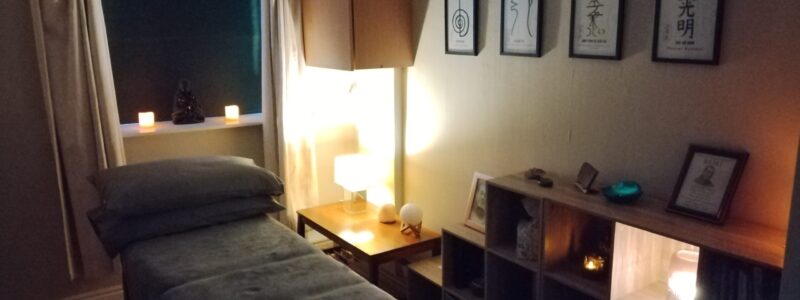
You remain fully clothed and lie on a treatment table.
The practitioner works gently, often in silence or with soft background music. Most people feel deeply relaxed, and some fall asleep entirely.
Cost: Sessions typically range from £40 to £80 in the UK, depending on location and the practitioner’s experience.
Some practitioners offer discounted rates or packages for ongoing treatment.
How many sessions? This varies enormously.
Some women notice a significant difference after one session; others find that a regular commitment say, monthly or fortnightly provides the most sustained benefit.
I generally suggest giving it three sessions before drawing conclusions.
A Final Word
I started offering Reiki to menopausal women not because I had read a paper about it, but because someone close to me asked me to.
Then they came because a friend had mentioned it, or because they were exhausted and willing to try anything, or because they simply needed somewhere quiet to fall apart safely.
What I’ve witnessed over the years has been remarkable, not miraculous, not magic, but real and meaningful.
Women leaving sessions standing a little taller.
Women sleeping through the night for the first time in months.
Women feeling, briefly, like themselves again.
That’s not nothing. In fact, for many of them, it’s been everything.
If you are navigating the menopause and looking for ways to support yourself through it, I hope this article has been useful.
Please reach out to a qualified practitioner, keep talking to your GP, and know that you do not have to endure this alone.
British Menopause Society: www.thebms.org.uk
NHS Menopause Overview: www.nhs.uk/conditions/menopause
NICE Guidelines NG23 Menopause: Diagnosis and Management: www.nice.org.uk/guidance/ng23
The Menopause Charity: www.themenopausecharity.org
Complementary and Natural Healthcare Council (CNHC): www.cnhc.org.uk
Macmillan Cancer Support Complementary Therapies: www.macmillan.org.uk
Baldwin, A.L. et al. (2010). Journal of Alternative and Complementary Medicine. https://doi.org/10.1089/acm.2009.0007
Thrane, S. & Cohen, S.M. (2014). Evidence-Based Complementary and Alternative Medicine. https://doi.org/10.1155/2014/945231
Richeson, N.E. et al. (2010). Journal of Alternative and Complementary Medicine. https://doi.org/10.1089/acm.2009.0378
Tsang, K.L. et al. (2007). Oncology Nursing Forum. https://doi.org/10.1188/07.ONF.E36-E44