Could Learning to Switch Off Be the Missing Part of Recovery?
What if the thing holding you back isn’t your training?
What if it’s your inability to stop?
Think about it.
You train hard. You eat reasonably well. You try to get enough sleep. You take your rest days seriously.
And yet your mind is still running.
You’re thinking about the next session. The competition. Your weight. Your performance. The things you didn’t get done today. The things you need to do tomorrow.
Your body may be lying still, but inside, you’re still running.
This is something we rarely talk about when we discuss athletic performance.
We have become remarkably good at understanding how to push the body, but perhaps we haven’t given quite as much attention to what happens when the pushing stops.
And that is where Reiki becomes particularly interesting.
Because Reiki asks you to do something that can feel surprisingly difficult for an athlete, a gym-goer, or frankly anyone living a busy modern life.
Nothing.
No reps.
No stopwatch.
No personal best.
No targets to hit.
You simply lie down, become still and allow yourself to receive.
For many people, that simple experience can be surprisingly powerful.
And perhaps there is more of a connection between Reiki and sport than you might initially imagine.
The part of recovery nobody puts on a training plan
When we think about recovery, we naturally think about muscles.
We think about protein, hydration, stretching, mobility, sleep and rest days.
And rightly so.
But there is another kind of fatigue that can be much harder to see.
Mental fatigue.
Emotional exhaustion.
The feeling of being permanently switched on.
A professional athlete may spend months preparing for a single event.
A recreational runner might spend six months training for a marathon while juggling a demanding job and family life.
A personal-training client may be trying to become fitter while simultaneously dealing with deadlines, relationships, financial worries and everything else that comes with being human.
Then we wonder why they struggle to recover.
Sometimes the body isn’t the only thing asking for a break.
The mind is too.
This is one reason Reiki can make sense as part of a wider approach to recovery.
A Reiki session creates a very different environment from a training session.
You aren’t being asked to push through discomfort.
You aren’t trying to improve anything.
You’re not competing with yesterday.
For a while, you simply stop.
And for someone who spends their life trying to achieve something, that can be quite an experience.
What actually happens during Reiki?
Reiki originated in Japan in the early twentieth century and is generally described as an energy-based complementary practice.
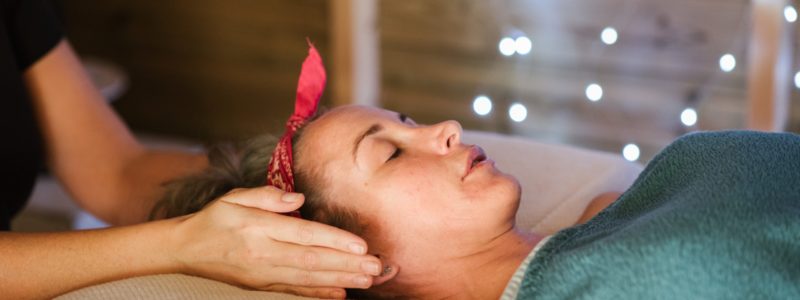
During a session, the recipient normally remains fully clothed while the practitioner places their hands lightly on, or just above, different areas of the body.
Reiki practitioners describe this as working with ki, or life energy.
People experience Reiki in different ways.
Some feel warmth.
Some notice tingling or a sense of movement.
Some become deeply relaxed or sleepy.
Others experience emotions, memories or sensations they weren’t expecting.
And some people feel very little during the session at all.
There is no “correct” Reiki experience.
But speak to people who regularly receive Reiki and one thing comes up again and again:
they enjoy how they feel afterwards.
They may feel calmer, more settled, lighter or simply more themselves.
And perhaps that is the most useful place to begin when considering Reiki and sport.
Not with the question, “Can Reiki make me a better athlete?”
But with a much more interesting question:
“Can learning to properly relax help me become better at recovery?”
We’ve been thinking about energy for a very long time
The idea that our wellbeing involves more than muscles, bones and organs isn’t new.
In traditional Chinese medicine there is the concept of qi.
Indian traditions speak of prana.
Japanese Reiki works with the concept of ki.
These traditions are not interchangeable, and each has its own history and philosophy.
But the recurring human fascination with vitality, energy and balance is difficult to ignore.
For thousands of years, people in different cultures have developed practices involving breath, movement, meditation, touch and awareness of the body with the intention of restoring balance and wellbeing.
Modern Reiki is one expression of that much older human interest.
Whether you understand Reiki as energy work, a deeply relaxing complementary practice, or something whose mechanism we don’t yet fully understand, the experience is meaningful to the people who receive it.
And that distinction matters.
We don’t have to pretend we have all the answers in order to take people’s experiences seriously.
What does the research say?
This is where Reiki becomes especially interesting because the research isn’t simply a case of “nothing has ever been studied”.
There have been clinical trials and systematic reviews investigating Reiki in relation to pain, anxiety, stress, mood and wellbeing.
A 2014 review of seven randomised trials found evidence suggesting Reiki may have beneficial effects on pain and anxiety, while also calling for larger and better-designed studies.
A 2021 systematic review examining Reiki and mental-health care identified 11 studies and concluded that the results suggested a potentially beneficial role, while again highlighting the need for stronger research.
More recently, a 2024 meta-analysis involving 824 participants reported a significant effect of Reiki interventions on anxiety, although the authors noted variation between studies and the need for further research.
So there is something worth investigating.
But there is also an important point that often gets lost in arguments about complementary therapies.
Research doesn’t have to have the final answer for an experience to be worth exploring.
Science is exceptionally good at measuring certain things.
It is less straightforward when we start asking questions about subjective experiences such as feeling peaceful, connected, emotionally lighter or deeply relaxed.
That doesn’t mean those experiences are imaginary.
It means there is still much to understand.
And perhaps that’s a more interesting position than simply declaring Reiki either “proven” or “unproven”.
Reiki and the NHS: perhaps more familiar than you think
For anyone who assumes Reiki exists entirely outside mainstream healthcare, the UK picture is worth exploring.
A number of NHS services have offered complementary therapies, including Reiki, alongside conventional care.
And one of the UK’s most interesting examples of integrative healthcare is The Christie NHS Foundation Trust in Manchester.
The Christie has an established complementary therapy service integrated into its rehabilitation work. Its current service includes therapies such as massage, aromatherapy, acupuncture/acupressure, reflexology, therapeutic touch, hypnotherapy and creative visualisation, with treatments available to patients and carers.
In June 2026, The Christie described its complementary and holistic therapies as part of the care it provides alongside clinical treatment, highlighting the role these approaches can play for people living with and beyond cancer.
It is important not to turn that into a claim that “the NHS has approved Reiki as a medical treatment”.
That isn’t what is happening.
The more interesting point is that integrative care is already a reality in parts of the UK healthcare system.
Conventional treatment and complementary approaches can exist alongside one another.
And that opens up a much broader conversation about wellbeing.
Because perhaps the question isn’t always “Which one is right?”
Perhaps sometimes it is:
“What else might help this person feel supported?”
Athletes are interested too
Reiki isn’t confined to hospital complementary-therapy departments or people seeking relaxation.
It has also attracted the attention of people operating at the highest levels of sport.
Former New York Giants NFL player Charles Way is one of the more interesting documented examples.
Way played five seasons in the NFL before moving into player development and support. During his time with the Giants, he became involved with Reiki practitioners who were exploring whether the practice could have a place around professional football.
Way’s involvement doesn’t prove that Reiki improves athletic performance.
But his interest is revealing.
Professional sport is an environment where almost everything is examined for potential benefit. Massage, physiotherapy, nutrition, sleep, psychology, recovery technology—the list is enormous.
Reiki was sufficiently interesting to someone inside that environment to be explored.
Then there is Ja Morant, the NBA star who spoke publicly in 2023 about receiving Reiki as part of a counselling programme and learning techniques to manage stress, alongside breathing work and therapy. Morant described feeling mentally better and learning different ways to manage stress positively.
Again, we shouldn’t turn a personal experience into proof.
But perhaps we shouldn’t dismiss it either.
Because Morant’s story highlights something important.
The value of energy work for an athlete may have nothing to do with gaining an extra five percent on the court.
It may have more to do with the person inside the athlete.
What if recovery is partly about your state of mind?
This is where things get really interesting.
Imagine two people finishing exactly the same training session.
Their physical workload is identical.
But one goes home, eats well, takes a shower and spends the evening feeling calm.
The other goes home exhausted but spends the next four hours worrying, scrolling, working and thinking about everything they need to do tomorrow.
Physically, they may have completed exactly the same workout.
But their experience of the following hours is completely different.
This is why relaxation deserves a place in the conversation about recovery.
I’m not suggesting that Reiki magically repairs damaged muscle tissue.
I’m suggesting something much simpler:
How you feel after training matters.
And if an athlete finds that Reiki helps them reach a state of calm, that may be useful to them.
Perhaps it becomes part of their evening routine.
Perhaps it helps them mentally draw a line underneath a difficult training day.
Perhaps it simply gives them an hour when they aren’t required to achieve anything.
Sometimes that may be enough.
And you don’t even have to be in the same room
One of the things many people don’t realise about Reiki is that it can also be offered remotely.
Remote Reiki, sometimes called distance Reiki, is based on the Reiki practitioner’s intention to work with the recipient even when they are not physically together.
For someone with a busy lifestyle, that can be surprisingly practical.
An athlete travelling for competition can receive a session from a hotel room.
A client who lives a long distance from their practitioner doesn’t have to travel.
Someone who has finished a late training session can simply get comfortable at home.
The experience is obviously different from being physically present with a practitioner, and people have different views about how remote Reiki works.
But it has also been the subject of research.
A published pilot study involving UK frontline healthcare workers investigated distance Reiki delivered remotely over four consecutive days. The researchers reported improvements in measures including stress, anxiety, pain, wellbeing and sleep. It was a small pilot study without a control group, so the findings should be viewed as encouraging rather than definitive.
Even so, it raises a fascinating question:
Does the value of a Reiki session depend upon physically being in the same room?
That is something researchers and practitioners will continue to explore.
What could a personal trainer take from all this?
This is perhaps the most practical part of the conversation.
A personal trainer can see things that don’t necessarily appear on a training plan.
The client who is exhausted.
The client who isn’t sleeping.
The person who keeps pushing despite feeling run down.
The person who thinks a rest day is a wasted day.
The client who has become obsessed with achieving a particular result and has forgotten to enjoy the process.
Sometimes the answer is another workout.
Sometimes it isn’t.
A good trainer knows the difference.
Reiki doesn’t need to become part of every client’s programme. It doesn’t need to be prescribed, and a trainer shouldn’t make medical claims about it.
But a trainer can recognise that recovery is not simply what happens when exercise stops.
Recovery is also about creating the conditions in which a person can rest, reset and return feeling ready to begin again.
For some people, that might mean meditation.
For another, massage.
For another, time outdoors.
For another, yoga.
And for some people, Reiki.
That doesn’t make one approach universally better than another.
It simply recognises that people respond to different things.
Perhaps we’ve been asking the wrong question
We’re obsessed with performance.
How much can you lift?
How fast can you run?
How quickly can you recover?
How many calories did you burn?
What’s your heart rate?
What’s your VO2 max?
What is your next goal?
But there is another question that may be just as important:
Can you switch off?
Because eventually, everybody has to stop.
The athlete.
The trainer.
The entrepreneur.
The parent.
The person who spends their entire life looking after everybody else.
We are remarkably good at encouraging people to become stronger.
Perhaps we should become equally comfortable encouraging them to become still.
And this is where Reiki offers something quite different.
It doesn’t ask you to try harder.
It asks you to receive.
Reiki isn’t about replacing what already works
There is no reason to throw out everything we know about training and recovery.
Sleep matters.
Nutrition matters.
Strength and conditioning matter.
Appropriate medical care matters.
Physiotherapy matters when you are injured.
Good programming matters.
Reiki doesn’t need to replace any of those things.
It can simply sit alongside them.
And perhaps that is one of the most sensible ways to approach energy work generally.
You don’t have to believe everything you read.
You don’t have to dismiss everything you can’t currently explain.
You can be curious.
You can experience something for yourself.
You can pay attention to how you feel.
And you can decide whether it has a place in your life.
The athlete who learns to stop
Perhaps the most interesting connection between Reiki and sport is also the simplest.
Both are concerned with the body.
But they approach it from completely different directions.
Training says:
Go further.
Lift more.
Run faster.
Push.
Reiki says:
Be still.
Breathe.
Listen.
Receive.
And maybe we need both.
Because becoming stronger isn’t only about how much stress we can put ourselves under.
It is also about how well we recover from it.
Perhaps the real benefit of Reiki for an athlete isn’t a mysterious boost in performance.
Perhaps it is something much more subtle.
The ability to step away from the constant demand to improve.
The chance to quiet the noise.
The feeling of being grounded again.
The reminder that you are a person before you are a performer.
And perhaps, after all the training, measuring, pushing and striving, that is something we could all use a little more of.
Because recovery isn’t the opposite of progress.
Recovery is where progress gets a chance to happen.
And sometimes the most productive thing an athlete can do…
is absolutely nothing.