It’s Not Woo Woo, It’s The Way
I have been a Reiki practitioner in Darwen, Lancashire, for over fifteen years.
In that time I have lost count of how many times someone has heard what I do and quietly filed it away under “woo woo.”
Sometimes it’s said with a smile, sometimes with a raised eyebrow, and sometimes with the kind of dismissiveness that tells you the conversation is already over before it’s begun. I understand where it comes from.
Reiki asks people to consider something they cannot see, measure with a ruler, or fully explain in a sentence.
For a lot of people, that is enough to close the door.
But I want to make the case, gently and without preaching at anyone, that the label “woo woo” says more about the limits of the observer than it does about the practice itself. History is full of ideas and treatments that were mocked, dismissed, or ignored right up until the moment they weren’t. I think Reiki, and practices like it, sit in that same uncomfortable middle ground today.
Not proven beyond doubt, not disproven either, and treated with a kind of casual contempt that isn’t really earned by the evidence, or by what’s actually happening in NHS wards and hospices up and down this country.
Where the dismissal comes from
Most people who call something “woo woo” aren’t cruel. They’re pattern matching.
If a claim doesn’t fit neatly into the framework of mechanisms they already understand, the easiest thing to do is put it in a box marked “not real” and move on.
That’s a completely normal human response.
The problem is that it treats personal unfamiliarity as though it were scientific proof, which it isn’t.
Not understanding how something works is not the same as knowing it doesn’t work.
It’s worth remembering that this pattern has played out before, repeatedly, in the history of medicine and wellbeing.
Meditation was once seen in Britain as fringe, something for monks and hippies, not something a GP would ever suggest.
Today mindfulness based cognitive therapy is recommended by NICE and offered through NHS talking therapies services. Acupuncture followed a similar arc, spending decades dismissed as folk superstition before enough clinical evidence built up that NICE’s 2021 guideline on chronic primary pain now lists it as a treatment to consider.
I raise these examples not to claim Reiki has reached that same level of acceptance, because it hasn’t, but to make a simpler point.
The gap between “we don’t yet understand the mechanism” and “this is nonsense” is real, and a lot of people collapse that gap without ever noticing they’ve done it.
Why alternative therapies rarely get a fair hearing
There’s another reason complementary therapies get dismissed as second rate, and it has nothing to do with whether they work.
It’s about money. A widely cited peer reviewed study published in PLOS Medicine found that the US pharmaceutical industry spent around $57.5 billion on marketing and promotion in 2004, compared with roughly $31.5 billion on research and development that same year, close to twice as much on persuading people to buy a product as on developing it.
That’s US data rather than UK figures, since the UK operates under stricter advertising rules through the ABPI Code of Practice, but the underlying picture still matters here.
A therapy backed by a multinational with that kind of promotional spend gets a huge head start in shaping what the public considers “credible” or “proven.”
A therapy passed down by small practitioners working from spare rooms and treatment clinics does not get that advantage, no matter how many patients quietly benefit from it.
This isn’t a conspiracy theory, and I’m not suggesting conventional medicine doesn’t work or shouldn’t be trusted, because plainly it does and it should.
It’s simply an observation about how visibility works in a market economy.
Reiki has no lobbying arm and no advertising budget.
What it has instead is word of mouth, patient testimony, and a slowly growing body of clinical curiosity from within the NHS itself.
That’s a much quieter, slower way to build a reputation, and it’s worth remembering when someone rolls their eyes at the word Reiki.
The absence of a marketing budget is not the same as an absence of merit.
What the research actually says
I think it does Reiki a disservice to overstate the evidence, so I want to be straightforward here rather than defensive.
Cancer Research UK states plainly on its own website that there isn’t strong scientific evidence to prove Reiki can treat cancer or any other illness.
The US National Institutes of Health takes a similar position, noting that Reiki hasn’t been clearly shown to be effective for any specific health condition, while also noting it hasn’t been shown to cause harm.
That’s an honest summary of where the formal evidence base currently stands, and I have no interest in pretending otherwise to my clients or to anyone reading this.
What that same research does consistently show is that people report feeling calmer, less anxious, and generally more able to cope after a session, even where the underlying mechanism isn’t yet understood by conventional science.
That gap between “not yet proven” and “clearly doesn’t work” matters.
It’s the same gap most complementary therapies sit inside while the research slowly catches up with what practitioners and patients have been observing for years.
What the NHS is actually doing
What I find more telling than laboratory data is what is already happening quietly inside British hospitals and hospices, institutions that are not exactly known for embracing anything without good reason, and that operate under constant scrutiny over how public money gets spent.
Reiki is offered as a complementary therapy for cancer patients at NHS trusts including Portsmouth Hospitals, South Tees Hospitals, Royal Cornwall Hospitals, and Guy’s and St Thomas’, usually delivered alongside Macmillan or hospice charity services to support people through chemotherapy, radiotherapy, and palliative care.
One of the most moving examples is the Sam Buxton Sunflower Healing Trust, founded by Angie Buxton-King after her son Sam died of leukaemia while being treated at University College London Hospitals.
Reiki was one of the things that eased his pain and anxiety at moments when he was too unwell to be touched in any other way.
The trust now funds Reiki and other complementary therapies for cancer patients in NHS units across the country.
Complementary practitioners working in or alongside the NHS in England are also expected to be registered with the Complementary and Natural Healthcare Council, the UK regulator set up with government backing to give patients confidence that a practitioner meets recognised standards of training, conduct, and insurance.
Most NHS services will only work with CNHC registered therapists.
That level of formal oversight doesn’t exist for something the system regards as pure fantasy.
I don’t think the NHS makes room for something at that scale purely on faith.
I think it happens because oncology nurses and ward staff keep observing, session after session, that patients receiving Reiki report feeling calmer, sleeping better, and coping more easily with pain and fear.
The body knows things the lab hasn’t confirmed yet
There is a well established concept in medicine called the relaxation response, first described by Harvard cardiologist Herbert Benson in the 1970s and still studied today at the Benson-Henry Institute for Mind Body Medicine at Massachusetts General Hospital.
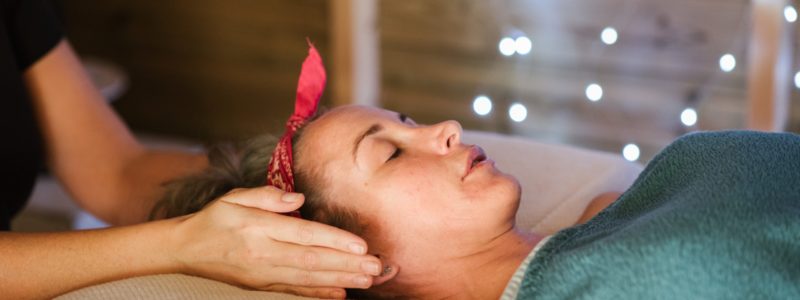
It refers to a measurable physiological shift, a lowered heart rate, reduced blood pressure, and slower breathing, that occurs when the body moves out of a stressed state and into a parasympathetic one. Whatever is happening in a Reiki session, whether you want to call it energy work, focused touch, or simply permission to be still for an hour, it consistently seems to trigger that same shift in the people I work with.
Their shoulders drop. Their breathing slows. Something in the nervous system recognises safety and responds to it.
Science also has a long and genuinely respectable history of taking the mind body connection seriously, even when it can’t yet map every mechanism behind it.
Ted Kaptchuk, a professor at Harvard Medical School, directs the Program in Placebo Studies and has spent decades showing that ritual, attention, and the quality of the relationship between practitioner and patient can produce real, measurable physiological change, not just reported change.
That doesn’t mean Reiki is “only” placebo, and I want to be careful not to let that word do more work than it should.
Placebo research of this kind suggests these effects involve genuine biological activity.
If part of what makes Reiki effective is the ritual of stillness, the safety of touch, and focused human attention, that isn’t a reason to dismiss it. It’s a reason to take more seriously how much of health and healing is shaped by things a purely mechanical view of the body has historically underestimated.
An old practice, not a new fad
Reiki isn’t a trend that appeared on social media a few years ago, even though its recent popularity might give that impression.
It was developed by Mikao Usui in Japan in the 1920s, growing out of a much older lineage of contemplative and healing practices in Japanese Buddhist tradition.
What I practise, Usui Reiki Ryoho, is the original system he founded, refined over a century by practitioners who passed it down teacher to student.
That doesn’t automatically make it correct, longevity isn’t proof of efficacy on its own, but it does undercut the idea that this is some flimsy modern invention dreamed up to sell candles and crystals.
It has a lineage, a discipline, and a body of accumulated practitioner experience spanning generations and cultures.
Why “the way” fits better than “woo woo”
I called this piece “It’s Not Woo Woo, It’s The Way” because I think that framing captures something the dismissive label misses entirely.
Reiki isn’t asking anyone to abandon medicine, reject their GP, or believe in something against all evidence.
In my own practice I am always clear with clients that Reiki sits alongside conventional healthcare, not instead of it.
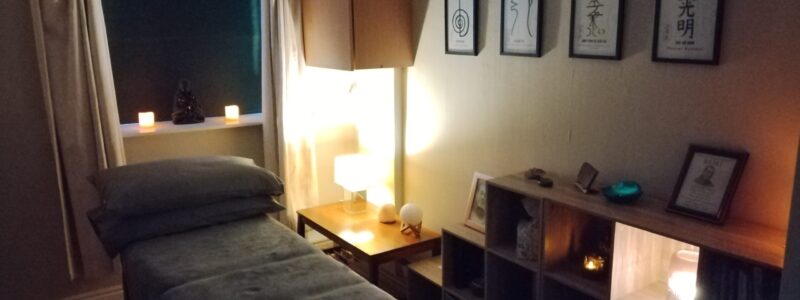
What it offers is a space for genuine stillness, focused human attention, and a kind of care that a rushed ten minute GP appointment simply isn’t built to provide.
In a culture where so many people are chronically overstimulated, disconnected from their bodies, and starved of unhurried attention from another person, that alone has value worth taking seriously, regardless of what you believe about energy fields, and regardless of which therapy has the bigger advertising budget behind it.
Whether the mechanism eventually gets explained through further biofield research, through the relaxation response, through the placebo literature, through some combination science hasn’t articulated yet, or through something we don’t currently have the instruments to detect, is almost secondary to the fact that people consistently walk out of these sessions calmer, more grounded, and better able to cope with what they’re facing. I see it every week in my treatment room in Darwen. I hear it from clients who came in sceptical and left surprised.
That pattern of consistent, repeated human experience is data too, even if it doesn’t fit neatly into a spreadsheet, and even if nobody is spending millions of pounds to broadcast it.
A more honest question to ask
I’m not asking anyone reading this to suddenly believe in energy fields or to abandon healthy scepticism.
Scepticism is useful.
It’s part of how bad ideas eventually get filtered out of good ones.
What I am asking is that the word “woo woo” gets retired as a substitute for actual thought. It’s a conversation ender dressed up as an argument.
A more honest question than “isn’t this all a bit woo woo” is simply “what is actually happening here, and why do NHS trusts, hospices, and cancer charities across the country keep quietly choosing to make space for it, fund it, and regulate it, without a single advert to convince them.”
I don’t think Reiki needs to be mystified or oversold to be worth taking seriously.
It needs to be looked at honestly, the way any practice with a genuine track record and a growing, if still young, body of research deserves to be looked at. Not woo woo. Just a quiet, unmarketed way of caring for people that the system is still learning how to measure.
Reiki is a complementary therapy.
It is not a substitute for medical diagnosis or treatment, and it should always be used alongside, not instead of, advice from your GP or specialist.
Alan Stuart is a Reiki Master practising Usui Reiki Ryoho from his home based treatment room in Darwen, Lancashire, with over fifteen years of experience.
You can find out more at reikination.co.uk.
Sources referenced in this article
Cancer Research UK, Reiki: complementary and alternative therapy
National Center for Complementary and Integrative Health (US NIH), Reiki
NHS, Mindfulness
NICE, Chronic pain (primary and secondary) in over 16s, NG193
Complementary and Natural Healthcare Council, cnhc.org.uk
Portsmouth Hospitals University NHS Trust, Complementary Therapies
South Tees Hospitals NHS Foundation Trust, Complementary therapy
Royal Cornwall Hospitals Charity, Reiki support for patients with cancer
Guy’s and St Thomas’ NHS Foundation Trust, Complementary therapies, Dimbleby Cancer Care
Sam Buxton Sunflower Healing Trust, cancertherapies.org.uk
Gagnon MA, Lexchin J (2008), The Cost of Pushing Pills, PLOS Medicine
Benson-Henry Institute for Mind Body Medicine, Massachusetts General Hospital, Relaxation response research
American Psychological Association, The power of the relaxation response
Harvard Magazine, The Placebo Phenomenon